Concrete Compressive Strength Analysis
Objective
This project addresses a fundamental challenge in civil engineering: predicting the load-bearing capacity of concrete mixtures without relying solely on time-consuming physical testing. By leveraging predictive modeling, we aim to optimize mixture ratios, reduce material waste, and improve structural safety standards.
Methodology & Approach
- Exploratory Data Analysis (EDA): Identified non-linear relationships between components (e.g., Cement, Water, Superplasticizer) and final strength.
- Feature Engineering: Employed Best Subset Selection to identify the most statistically significant predictors, reducing model complexity while maintaining predictive power.
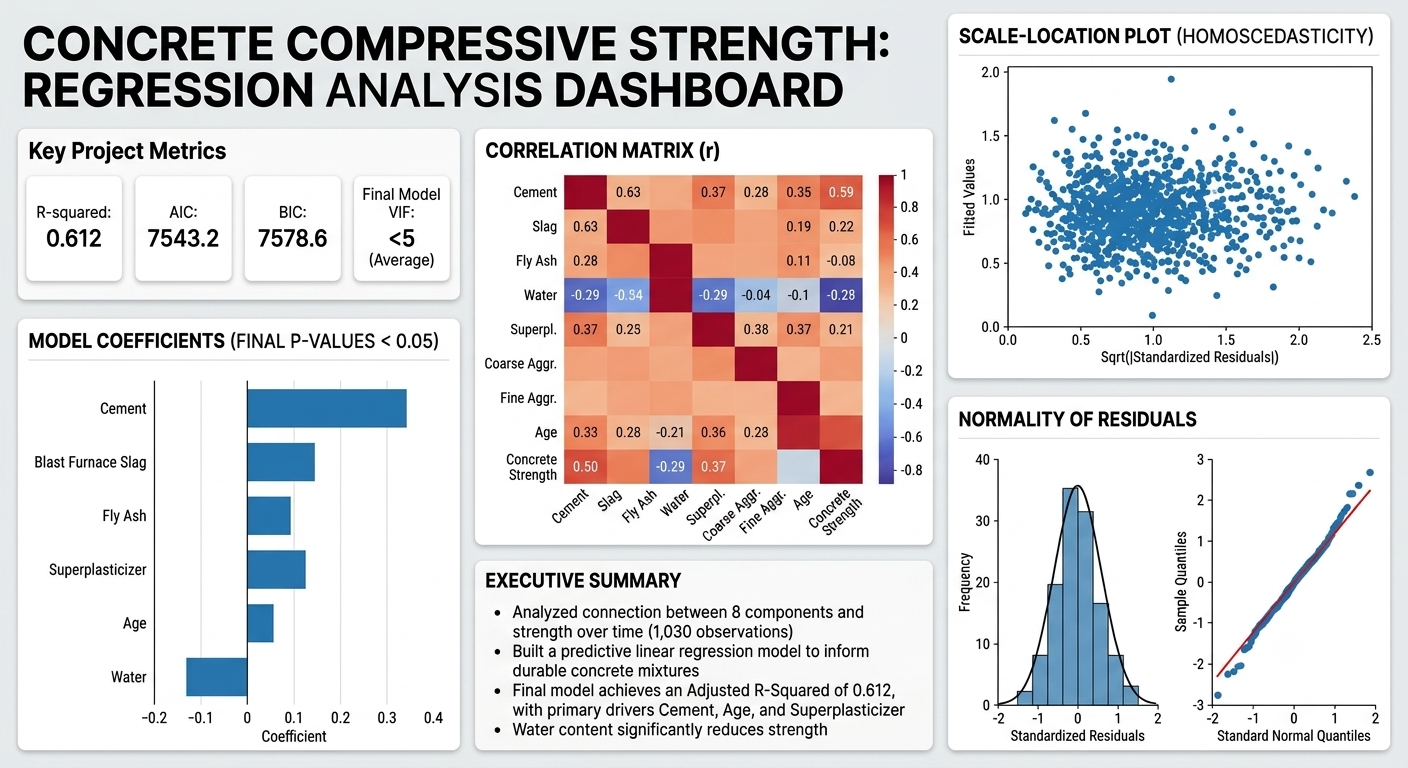
- Diagnostic Validation: Conducted Multicollinearity Analysis (VIF) to ensure model stability and performed Residual Analysis (Residuals vs. Fitted, Q-Q Plots) to validate homoscedasticity and normality assumptions.
Key Findings
The developed regression model successfully accounts for 61.2% of the observed variation in compressive strength. Statistical analysis confirmed that Cement, Water content, and Age are the primary drivers of strength development. The resulting model serves as a robust decision-support tool for engineers to iterate on concrete formulas effectively.
Technical Stack
| Category | Tools |
|---|---|
| Languages/Libs | Python, Pandas, Scikit-Learn, Statsmodels, Matplotlib, Seaborn |
| Methods | Linear Regression, Polynomial Regression, Confidence Intervals |
| Optimization | Best Subset Selection, AIC, BIC |
| Validation | VIF, Residual Analysis, Q-Q Plotting |